
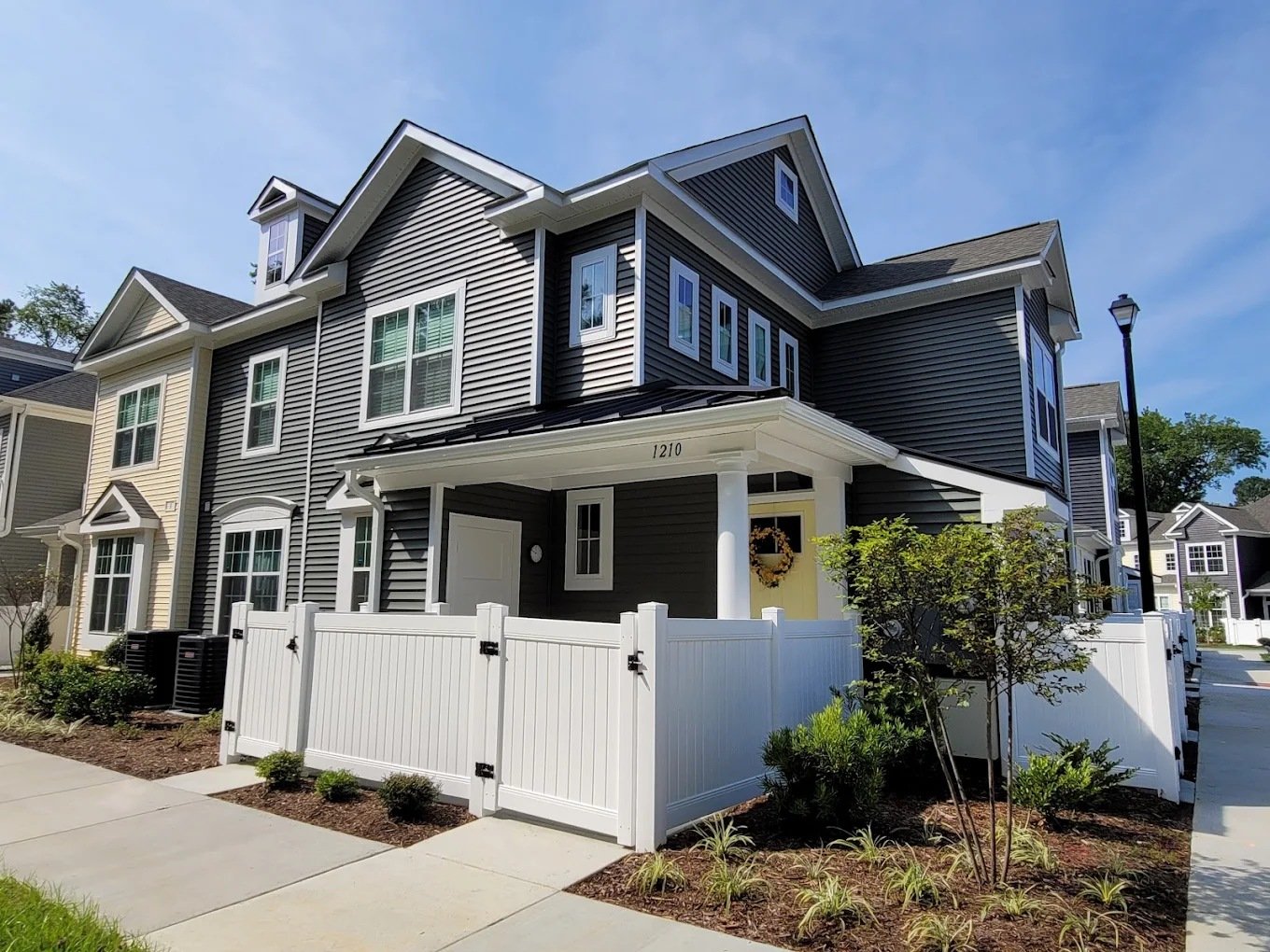
Photo by Joe Ellington, Capital ValuationsThis guide helps buyers and agents understand the sales comparison grid in a home appraisal. I’ll explain how adjustments work, why a lower sale price can still support your home’s value, how living-area adjustments differ from price per square foot, and what to provide for a value review.
How adjustments account for differences between homes
The subject is the home being appraised. The grid compares it with similar homes that have sold. Each comparable’s sale price is adjusted for differences that buyers value, such as living area, overall condition or a garage. [1]
Imagine two otherwise similar 1,000-square-foot homes. One sells for $100,000 without a garage; the other sells for $105,000 with one. If other price influences are equal, the $5,000 difference suggests what buyers paid for the garage. Even if it cost $10,000 to build, its contribution to value may be only $5,000. [2]
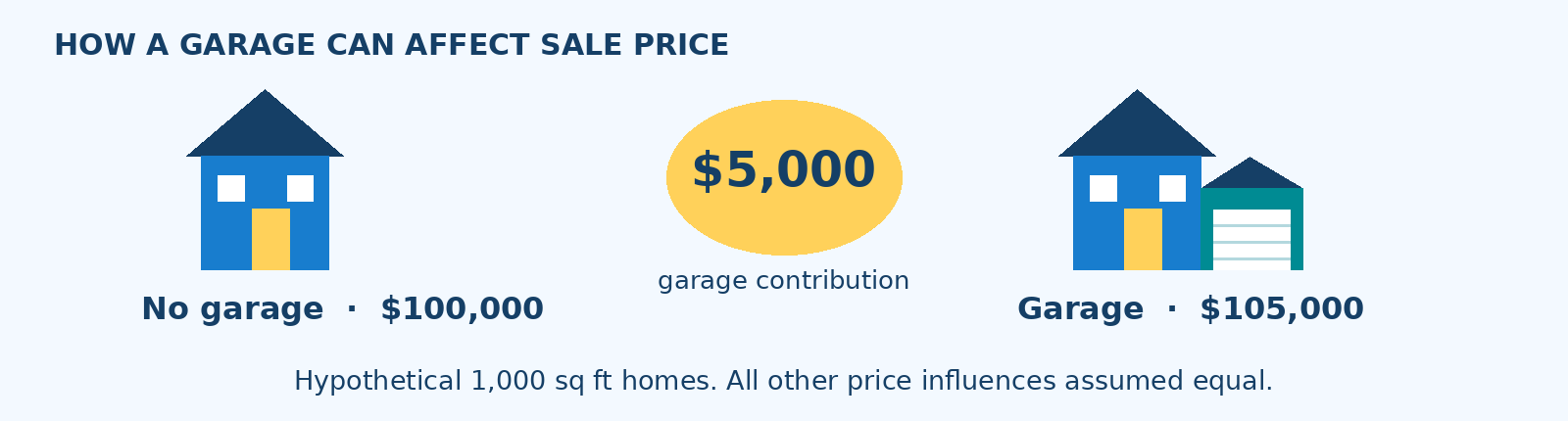
Illustrative paired sales example.If your home has a garage and the comparable does not, the appraiser adds the supported adjustment to the comparable’s price. If the comparable has the garage and your home does not, the appraiser subtracts it.
Why you should compare adjusted sale prices
In this example, the subject has 2,000 square feet. Read each sale’s column downward to see how a 100-square-foot difference affects its adjusted price.
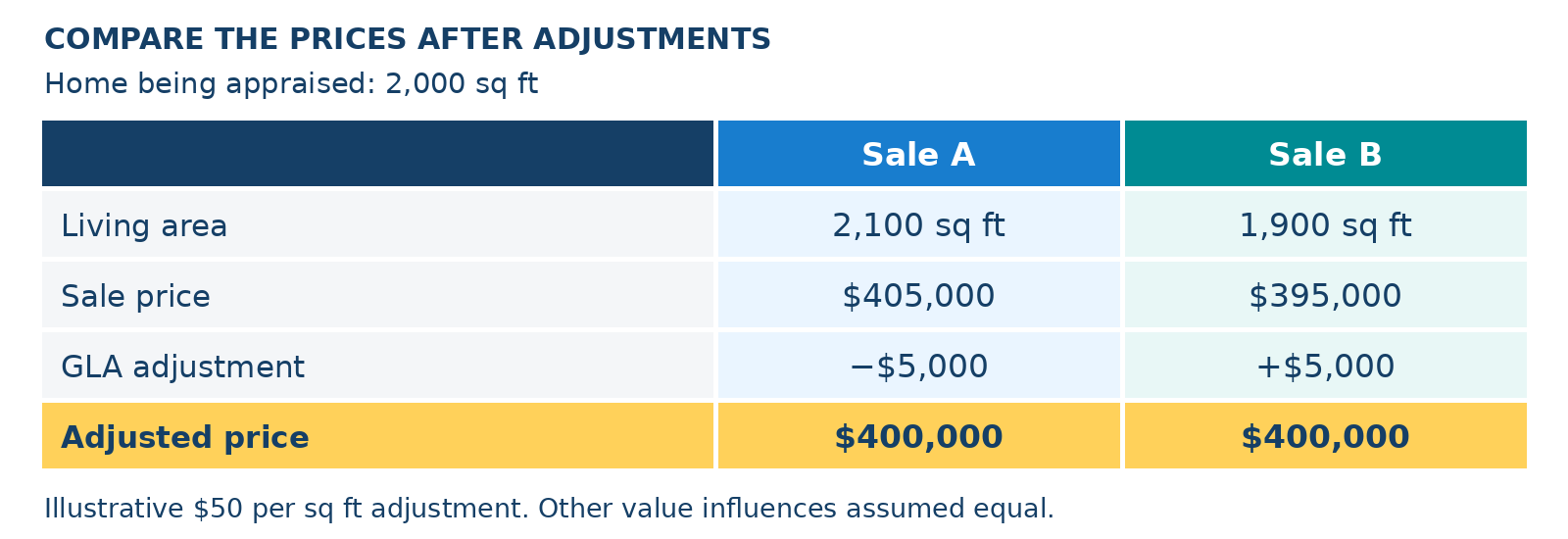
Teaching example only. Actual adjustments require market support.The $395,000 sale supports the same $400,000 indication as the higher-priced sale. I weigh similarity and reliable information; neither the highest price nor the fewest adjustments automatically makes a sale the best evidence. [1][3] My guide to finding and verifying comparable sales explains how I research them.
How the GLA adjustment differs from price per square foot
Gross living area (GLA) measures the home’s qualifying finished living space above ground. Basements and garages are reported separately. The dollar adjustment beside GLA reflects what buyers pay for a difference in living area. [1][6]
Price per square foot divides the entire sale price by the living area. A $400,000 sale with 2,000 square feet averages $200 per square foot. That sale price includes the land, garage and other property features.
The GLA adjustment isolates the contribution of extra living space. Extra space does not add another lot or garage. If market evidence supports $50 per additional square foot, a 100-square-foot difference warrants $5,000, not $20,000 using the overall $200 average. The $50 rate is hypothetical, not a standard. [1][4]
What to give the appraiser for a reconsideration of value
A reconsideration of value (ROV) requests a review of a suspected error or missing information. For a lender-ordered appraisal, use your lender’s process and provide the applicable items below:
The report item you believe is incorrect, with supporting records.
Any proposed closed sales with addresses, sale dates, prices and data sources.
Why each proposed sale is more comparable than those used, considering location, size and overall condition.
Fannie Mae’s borrower-initiated process allows up to five proposed comparables; three is not mandatory. Active or pending listings can provide context but do not establish closed sale prices. Follow your lender’s instructions. [3][5]
I review new information because I can overlook something too. I have changed conclusions when the evidence warranted it.
Joe Ellington is a Licensed Residential Appraiser with 20+ years of appraisal experience, serving Hampton Roads through Capital Valuations.
Sources
1. Market adjustments | 2. Cost and contributory value | 3. Comparable sales | 4. GLA adjustment methodology | 5. ROV requirements | 6. Living area reporting